
Contents
Last updated: June 29, 2026.
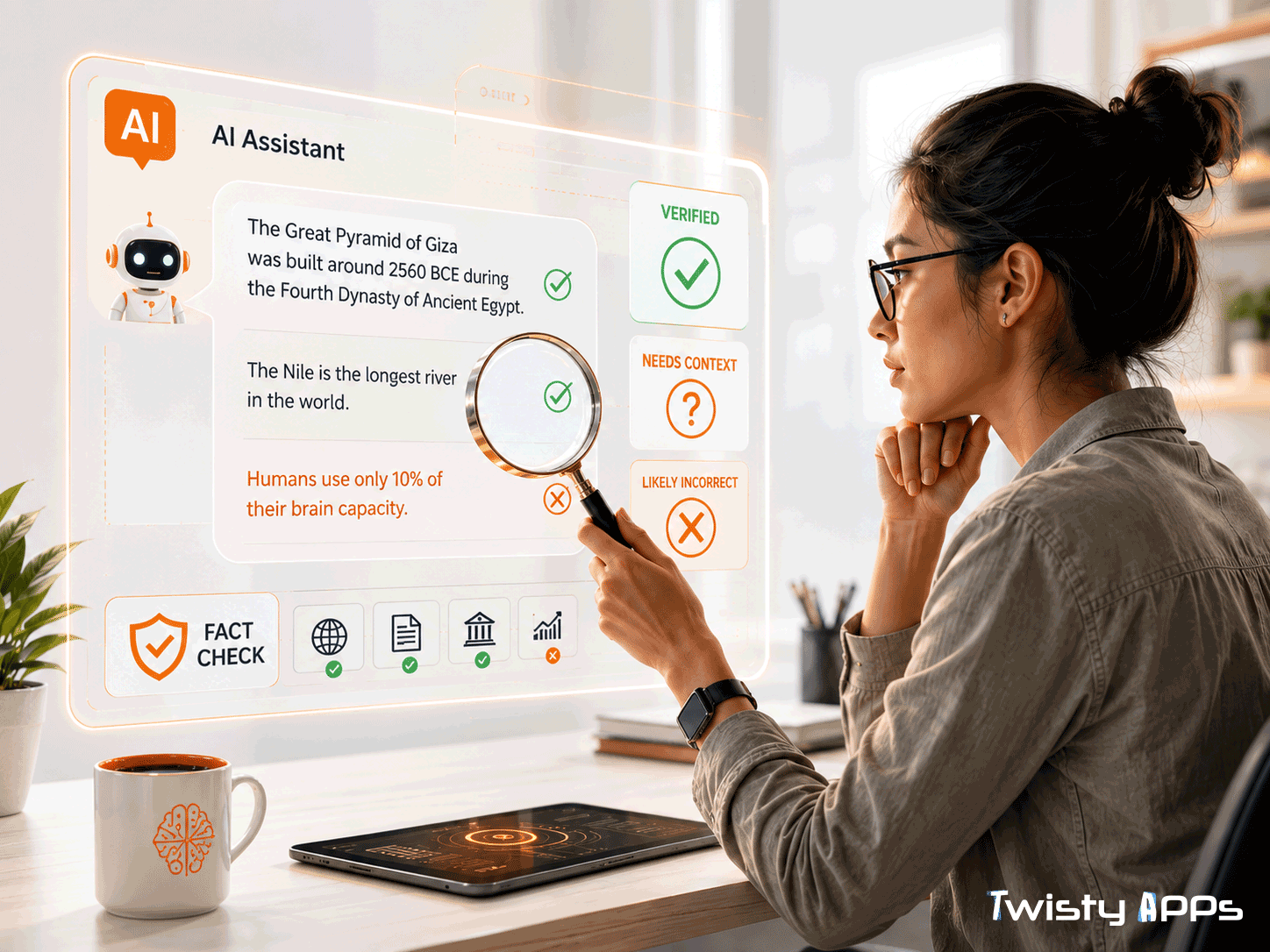
AI can help you move faster, but it can also produce confident mistakes. That matters when you use AI for blog posts, client work, school assignments, business decisions, product research, or technical instructions. A polished answer is not always a correct answer. This guide gives you a simple, repeatable way to verify AI-generated information before you trust or publish it. It is written for everyday users, not only technical experts.
Quick answer
To check an AI answer: (1) spot the claims that would cause real harm if wrong, (2) ask the AI for sources and then actually open them, (3) cross-check any high-stakes claim against a second reliable source, (4) confirm the information is current for 2026, and (5) add your own explanation or example. If a claim affects money, health, safety, law, or your reputation, verify it before you act on it or publish it.
Try it in two minutes: the free AI Answer Verification Checklist turns this method into a quick risk level and a list of exactly what to check.
Who this guide is for
This is for anyone who relies on AI answers but cannot afford to be wrong: students checking facts for assignments, bloggers and freelancers publishing AI-assisted drafts, small business owners making decisions, and beginners who are not sure how much to trust a chatbot. You do not need any technical background to follow it.
Why AI answers need checking
AI assistants generate answers based on patterns, context, training data, connected tools, and your instructions. They are often genuinely helpful, but they may misunderstand your question, miss recent updates, invent details, or mix correct and incorrect information inside the same paragraph. When an AI states something false in a fluent, confident way, that is often called an “AI hallucination.” It simply means the model produced text that sounds right but is not backed by real facts.
The risk is higher when the topic changes often or affects real decisions. Dates, prices, laws, medical advice, financial information, software versions, product availability, and technical commands should always be checked before use.
Not every claim needs the same scrutiny
You do not have to fact-check every sentence. Match your effort to the risk. Use this as a rough guide for how hard to verify a claim before trusting it.
| Type of claim | Risk if wrong | How much to verify |
|---|---|---|
| Prices, plans, free limits | High | Always check the official page. These change often. |
| Health, legal, financial advice | High | Confirm with an official or professional source. Do not rely on AI alone. |
| Statistics, dates, quotes | Medium to high | Trace to the original source. AI often misattributes numbers. |
| Software steps, commands, code | Medium to high | Check current docs and test safely before running anything destructive. |
| General explanations, definitions | Lower | A quick sanity check is usually enough. |
A simple 5-step process to verify AI answers
Step 1: Identify the risky claims
Do not waste time checking every harmless sentence. Start by highlighting claims that could cause problems if wrong. Examples include “this product supports…”, “the price is…”, “the law requires…”, “the latest version is…”, “this medicine…”, or “this command will delete…”. If you are reviewing an AI-written blog post, scan for names, dates, statistics, quotes, feature claims, comparisons, and recommendations. These are the parts that need evidence.
Step 2: Ask for sources, then open them
You can ask AI for sources, but do not stop there. Open the sources yourself and confirm that they actually support the claim. Sometimes a source is real but does not say what the AI claims. Sometimes the link is outdated or points to the wrong page. Sometimes the source is not reliable enough for the topic. Prefer primary sources when possible: official documentation, company announcements, government pages, academic institutions, product pages, and direct data providers. For news, compare reputable publications and check publication dates.
Step 3: Compare at least two sources for important claims
For high-impact information, one source may not be enough. Compare two or more reliable sources, especially when the claim involves money, safety, health, legal rules, or major buying decisions. If sources disagree, mention the uncertainty instead of pretending the answer is settled. For product comparisons, check the official feature page and at least one independent review or hands-on source. For software, check official release notes and current documentation.
Step 4: Check the date and version
AI content can become outdated quickly. A guide that was accurate last year may be wrong today. Always check whether the source is current, whether the product has changed, and whether your article should include a “last updated” date. This is especially important for AI tools, because model names, pricing, limits, features, and availability can change fast. The model comparison in GPT-5.2, Gemini 3 and Claude Opus 4.1 is a good example of a topic that needs current official sources.
Step 5: Add human value
Google’s people-first content guidance asks whether a page provides original information, complete coverage, useful analysis, and a satisfying experience. A verified article should not only repeat what other pages say. Add examples, screenshots, use cases, limitations, and clear next steps. Human value can be simple: explain who the advice is for, when it does not apply, what a beginner should do first, and what mistakes to avoid.
Quick verification checklist
- What exact claim am I checking?
- Is the source primary, reliable, and current?
- Does the source actually support the claim?
- Would a wrong answer affect money, safety, trust, or reputation?
- Have I added my own explanation or practical example?
- Does the final article make uncertainty clear where needed?
That checklist is the manual version. This does the same job in about ninety seconds and gives you a risk level with it.
AI Answer Verification Checklist
Know exactly what to fact-check before trusting AI.
Example workflow for blog posts
Here is a simple loop that keeps AI useful without letting it publish unchecked information on your behalf:
- Ask AI for an outline.
- Ask it to mark the claims that need sources.
- Collect and open the sources yourself.
- Draft the post.
- Ask AI to review the draft for missing questions and unclear sections.
- Do a final human edit for accuracy and tone.
Common mistakes to avoid
- Trusting a confident tone. Fluent and certain wording is not evidence. Hallucinations usually sound just as confident as facts.
- Accepting cited links without opening them. A citation that you never read is not verification.
- Ignoring the date. Old prices, model names, and features are a top source of AI errors.
- Asking the same AI to “double-check” itself. It can repeat the same mistake with more confidence. Use an independent source.
- Publishing without adding anything human. Unedited AI text rarely meets people-first standards and adds little value for readers.
Read next on TwistyApps
- Can AI Content Be Detected? A practical look at AI detectors and what they really catch.
- Is My Data Safe With AI Tools? What happens to what you type into AI chatbots.
- How to Learn Prompting for Free Write clearer prompts so you get more accurate answers.
- Best AI Tools for Beginners in 2026 Pick a reliable tool to start with.
- Learn AI in 30 Days A step-by-step beginner training plan.
Frequently asked questions
Can AI tools give wrong answers even when they sound confident?
Yes. AI predicts likely wording, so it can state something false in a fluent, confident way. This is called a hallucination. Confidence is not proof, so always verify high-stakes claims against a reliable source.
Which AI answers should I always double-check?
Anything that affects money, health, safety, legal rules, or your reputation: prices and plan limits, statistics, medical or financial advice, software commands, and current product details. These change often or carry real consequences.
Are the sources an AI gives me reliable?
Not always. AI can cite real sources that do not actually support the claim, outdated pages, or weak sites. Open every source yourself and confirm it says what the AI claims before you trust it.
Can I trust AI for medical, legal, or financial questions?
Use AI to understand a topic, but do not treat it as professional advice. For decisions with real consequences, confirm with an official source or a qualified professional.
Does asking the AI to check its own answer work?
It can help surface obvious gaps, but the same model can repeat the same mistake with more confidence. The reliable check is an independent source, not the AI reviewing itself.
Bottom line
AI is best used as a fast assistant, not as the final authority. Trust improves when you verify claims, use current sources, and add your own explanation. If an answer matters, check it before you act on it or publish it.
New to AI tools?
Start with our Best AI Tools for Beginners in 2026 guide, then follow the 30-day beginner training plan to build confidence step by step.