
Contents
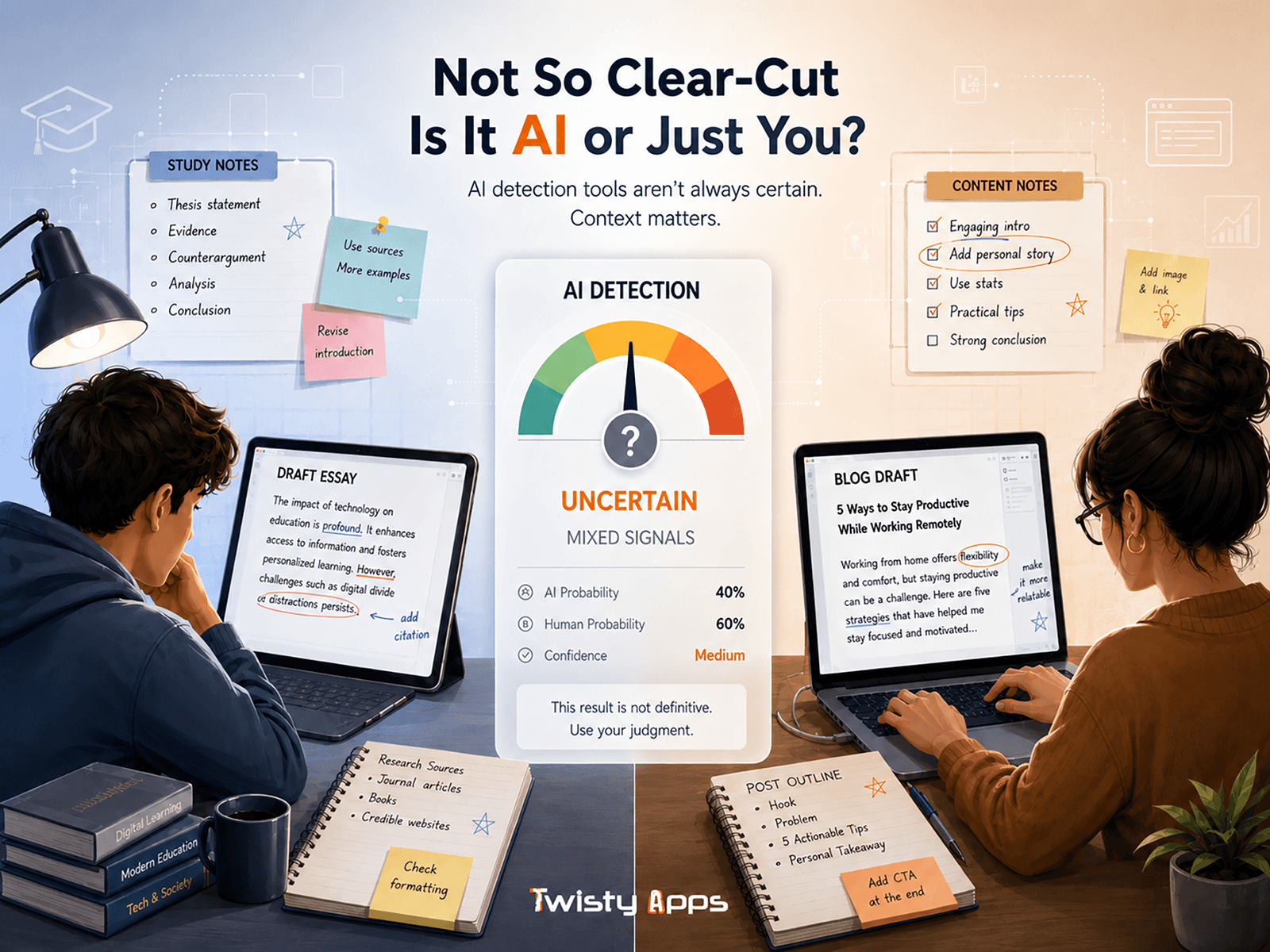
AI-generated writing can sometimes be detected, but no detector can reliably prove who wrote a document. AI detectors estimate whether text resembles patterns associated with machine-generated writing. They can produce false positives, miss AI-written passages, and disagree with one another.
That distinction matters. A detector result may justify a closer review, but it should not be treated as a final verdict. Students need to follow their institution’s AI policy and preserve evidence of their writing process. Bloggers and professionals need to focus on accuracy, originality, useful experience, and editorial review—not on achieving a particular detector score.
Free tool: before you trust an AI answer, the AI Answer Verification Checklist shows exactly what to fact-check. You can find it and five more on the free tools page.
Quick answer
Yes, AI content can sometimes be flagged by detection software. However, the result is a probability or classification, not proof of authorship. OpenAI withdrew its own text classifier in July 2023 because of its low accuracy. Turnitin acknowledges that false positives can occur and says educators must use professional judgment and assignment context. The safest approach is not to “beat” a detector. It is to follow the applicable rules, keep drafts and research notes, verify important claims, and be able to explain how you created the work.
Who this guide is for
- Students using AI for explanations, study plans, brainstorming, or permitted editing.
- Bloggers using AI for research questions, outlines, or draft improvement.
- Freelancers and professionals working under client or employer AI policies.
- Teachers, editors, and managers who need to interpret an AI-detector result carefully.
- Beginners who confuse AI detection with plagiarism checking.
How AI content detectors work
Most AI-writing detectors analyze patterns in text. Depending on the tool, those patterns may include how predictable the wording is, how sentence structures vary, how frequently particular transitions appear, or how closely the writing resembles examples used to train the detector.
The software then returns a label, score, or highlighted passage. It may say that a document is “likely AI-written” or estimate that a percentage of qualifying text resembles AI output.
This does not reveal the actual writing history. A detector normally cannot see whether the author wrote the first draft personally, used AI only to brainstorm, used a grammar or translation tool, rewrote an AI-generated outline, copied an AI response without permission, or collaborated with another person. The detector sees the submitted text, not the complete process that produced it.
AI detection is not the same as plagiarism detection
These tools answer different questions.
| Check | What it looks for | What the result means | Main limitation |
|---|---|---|---|
| Plagiarism or similarity checker | Text matching existing sources or databases | Parts of the document resemble other material | A match still needs quotation, citation, and context review |
| AI-writing detector | Statistical or stylistic patterns associated with generated text | The text resembles patterns the model associates with AI | It does not prove who wrote the text or how AI was used |
| Human editorial review | Reasoning, sources, consistency, knowledge, and writing process | A reviewer forms a contextual judgment | Human judgment can also be incomplete or biased |
| Version history and notes | Evidence showing how the work developed | Supports an authorship or process explanation | It must be preserved before a dispute occurs |
Similarity can often be investigated by opening the matching source. An AI-detection score usually does not provide equivalent evidence showing when, where, or by whom the words were generated.
How accurate are AI detectors?
Accuracy varies by tool, model, language, document length, writing style, and testing method. That makes a single marketing accuracy claim difficult to apply to every real assignment or article.
OpenAI’s discontinued classifier correctly labeled only 26% of AI-written text as “likely AI-written” in its published challenge-set evaluation and incorrectly labeled human text as AI-written 9% of the time. OpenAI said the classifier should not be a primary decision-making tool.
A peer-reviewed study that tested 14 detection tools concluded that the tested systems were neither accurate nor reliable overall. The researchers warned against using detector reports as the only basis for an academic-misconduct allegation.
Turnitin reports a low false-positive target for its system, but it also explicitly acknowledges that the risk is not zero. Its guidance says the company provides information for educators; it does not determine misconduct.
Important: These findings do not mean every detector result is useless. They mean the result needs context, corroboration, and a fair review process.
Why human writing can be flagged
A false positive happens when human-written work is classified as AI-generated. It can occur because human and AI writing patterns overlap.
Clear grammar, predictable structure, repeated academic phrases, short factual answers, formulaic business writing, or limited sentence variation may look statistically predictable. That does not prove AI use.
Language background also matters. Stanford researchers reported that seven detectors in their study incorrectly classified 61.22% of the tested TOEFL essays by non-native English writers as AI-generated. Turnitin was not one of the seven tools in that study, so the finding should not be applied automatically to every detector. It does show why institutions should evaluate bias and avoid treating a score as conclusive evidence.
What students should do before submitting work
1. Read the actual AI policy
Do not assume every class has the same rule. One instructor may permit brainstorming but prohibit generated prose. Another may allow AI-assisted editing with disclosure. A third may prohibit AI entirely for a particular assessment.
Check the syllabus, assignment instructions, academic-integrity policy, and any required citation format. If the rule is unclear, ask the instructor before submitting.
2. Use AI only within the allowed boundary
Permitted uses may include asking for a concept explanation, creating practice questions, identifying gaps in an outline, or improving grammar. Permission depends on the institution and assignment.
If AI-generated sentences are prohibited, rewriting them only to avoid detection does not make the use acceptable. The policy concerns the work and learning process, not merely whether software catches it.
3. Preserve evidence of your process
- The assignment brief and research notes.
- Source links and citation records.
- Early outlines and rough drafts.
- Document version history and teacher feedback.
- Relevant AI prompts and responses when disclosure is required.
- A short note explaining what AI did and what you did.
This material helps you explain your reasoning and demonstrate how the document developed.
4. Verify facts and citations
AI can invent references, misstate research, and combine correct and incorrect claims. Open every source. Confirm that the author, title, date, quotation, and conclusion are real and relevant.
Use our guide to check AI answers before trusting them for a practical verification process.
5. Make the learning visible
Be prepared to explain the thesis, evidence, calculations, or choices in your own words. If you cannot explain a submitted paragraph, that is a deeper problem than its detector score.
What to do if your work is flagged as AI
Stay calm and follow the institution’s review process.
- Ask which policy and evidence are being applied.
- Request a conversation rather than arguing only about the detector percentage.
- Show your notes, sources, drafts, timestamps, and version history.
- Explain how you developed the argument and why you selected the evidence.
- Disclose any permitted AI use accurately.
- Ask whether you can demonstrate knowledge orally or through a supervised revision.
- Use the formal appeal process if the matter is not resolved fairly.
Do not fabricate drafts after an accusation. Do not upload private schoolwork to several unknown detector websites, because doing so may create privacy or intellectual-property concerns. Review our guide to protecting your data when using AI tools.
A responsible AI workflow for bloggers
Bloggers face a different question. Google’s published guidance does not say that all AI-assisted content is automatically unacceptable. It says website owners should focus on accuracy, quality, relevance, and user value. Generating many pages without adding value may violate Google’s scaled-content-abuse policy.
Step 1: Start with a real reader problem
Define the reader, decision, risk, and next action before opening an AI tool.
Step 2: Use AI for assistance, not authority
AI can help organize questions, identify missing sections, or improve clarity. It should not be the unverified source of prices, policies, statistics, quotations, or recommendations.
Step 3: Research primary sources
Collect official documentation, academic research, company policies, or direct data. Keep a source log.
Step 4: Add original editorial value
Add practical examples, screenshots you created, tested steps, limitations, comparisons, or experience you can honestly support. Do not invent personal testing.
Step 5: Review every claim
Check dates, links, names, quotations, and changing product information. Remove claims you cannot support.
Step 6: Give readers useful context
When AI materially helped create the page, consider explaining the process where disclosure would help readers understand the content. Google specifically notes that information about how content was created can provide useful context.
Step 7: Ignore detector-score chasing
A low AI score does not make an article accurate, original, or helpful. A high score does not automatically prove the article was generated. Editorial quality is the real publishing standard.
Practical examples
Student example
A student asks AI to explain a difficult theory, closes the chat, reads two assigned sources, creates an outline, and writes the essay independently. Whether disclosure is required depends on the course policy. The student should preserve notes and be able to explain the theory.
Blogger example
A blogger uses AI to list beginner questions about software, then checks official documentation, tests the workflow, takes original screenshots, writes the article, and records the update date. The value comes from verified research and editorial work.
Professional example
An employee uses an approved workplace assistant to improve a report’s clarity, checks every figure, and keeps responsibility for the final wording. Employer data and disclosure policies still apply.
Common mistakes
- Treating a detector percentage as proof.
- Assuming plagiarism and AI detection are the same.
- Submitting generated text without understanding it.
- Using “humanizer” tools to hide prohibited AI use.
- Deleting drafts and notes after submitting.
- Uploading confidential work to unknown detector websites.
- Publishing AI drafts without checking sources.
- Believing Google rewards content because it appears human-written.
- Accusing a student, writer, or employee using one automated score.
Final recommendation
AI content can sometimes be detected, but detection is probabilistic and imperfect. Students should follow assignment rules, preserve their writing process, and disclose AI use when required. Bloggers should build a source-backed editorial workflow and judge content by accuracy, originality, usefulness, and transparency. Use detector results as one possible signal, never as unquestionable proof.
For a broader learning path, follow our 30-day beginner AI training plan. You can also learn prompting without paid courses while keeping responsible-use rules in mind.
Sources and references
- Turnitin: Understanding false positives within AI writing detection
- OpenAI: New AI classifier for indicating AI-written text
- International Journal for Educational Integrity: Testing of detection tools for AI-generated text
- Stanford HAI: AI detectors biased against non-native English writers
- Google Search Central: Guidance on using generative AI content
Frequently asked questions
Can Turnitin prove that a student used AI?
No. Turnitin provides an AI-writing indicator for educator review, but its own guidance says it does not determine misconduct. A fair decision also needs policy, assignment context, professional judgment, and discussion with the student.
Can human-written work be detected as AI?
Yes. False positives can occur because human writing can share statistical and stylistic patterns with generated text.
Can an AI detector identify which tool wrote the text?
Usually not with dependable certainty. A detector may classify text as resembling AI output, but that is different from proving that a specific model or account generated it.
Does Google penalize every AI-written blog post?
Google’s guidance focuses on accuracy, quality, relevance, and value. Using automation to create many low-value pages may violate spam policies, but AI assistance alone is not the complete quality judgment.
Should I run my essay through several AI detectors before submitting?
Not necessarily. Different tools can disagree, and uploading unpublished work to unknown services can create privacy concerns. Following the policy and keeping evidence of your process is more useful.
How can I prove that I wrote my work?
Keep outlines, notes, sources, rough drafts, timestamps, and version history. Be ready to explain your reasoning and accurately disclose any allowed AI assistance.
Is using a grammar checker considered AI use?
It depends on the tool’s features and the applicable policy. Basic corrections and generative rewrites may be treated differently. Check the assignment, workplace, or client rules rather than guessing.
Document the process, not just the final text
Responsible writers spend less time chasing detector scores and more time following policy, checking sources, preserving drafts, and producing work they can explain.