

Contents
You have seen the headlines. A company cuts its engineering team, a founder brags that AI now writes most of their code, and a manager who has not shipped in years suddenly builds an internal tool over a weekend. If you write software for a living, or you are studying to, it is hard not to read all of that as a countdown clock on your own job.
Here is the calmer truth. AI is reshaping software development jobs, but the panic and the reality are not the same thing. The people getting squeezed are the ones whose entire value was “I can produce code.” The people getting pulled up are the ones who can decide what is worth building and make it hold up in the real world. This guide walks through what is actually happening, the five software roles where demand is concentrating in 2026, and the specific moves that keep you hireable.
Quick answer
AI is reshaping software jobs, not erasing them. The roles growing fastest are the ones where a human still owns judgment, cost, and consequences: AI/ML, AI application, data, security, and platform work. To stay hireable, shift from typing code to deciding what to build and proving it works, and learn to use AI as a force multiplier instead of fearing it.
This is you if
You are an early-career developer worried your skills will be obsolete before you pay off your learning.
Or this is you if
You are a mid-level engineer watching layoffs and wondering which way to grow next.
Or this is you if
You are a CS student or self-taught coder asking whether software is still worth entering in 2026.
What is actually happening to software jobs
Start with the headlines, because they are not wrong that cuts are happening. Tech layoffs have stayed high and choppy for two years straight, with fresh spikes as recently as mid-2026.
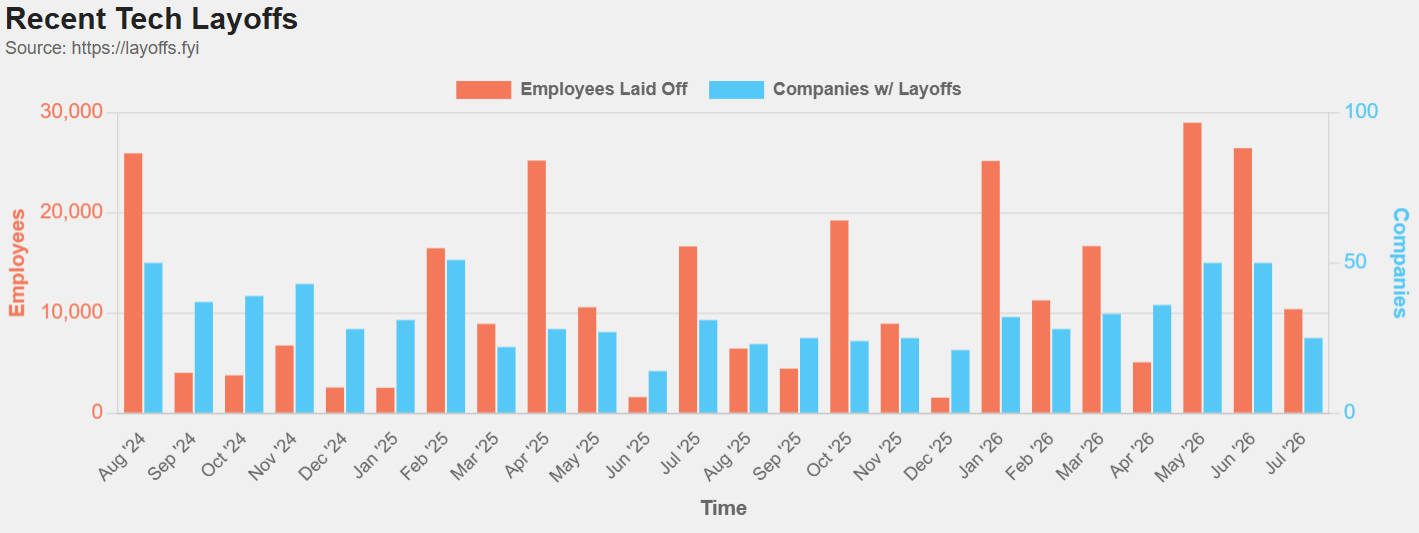
But “AI took the jobs” is too neat. Look at how many of those layoffs are actually attributed to AI. For most of 2024 and early 2025 that share was small. Only in the most recent quarters has it climbed to become the larger part of tracked tech layoffs.
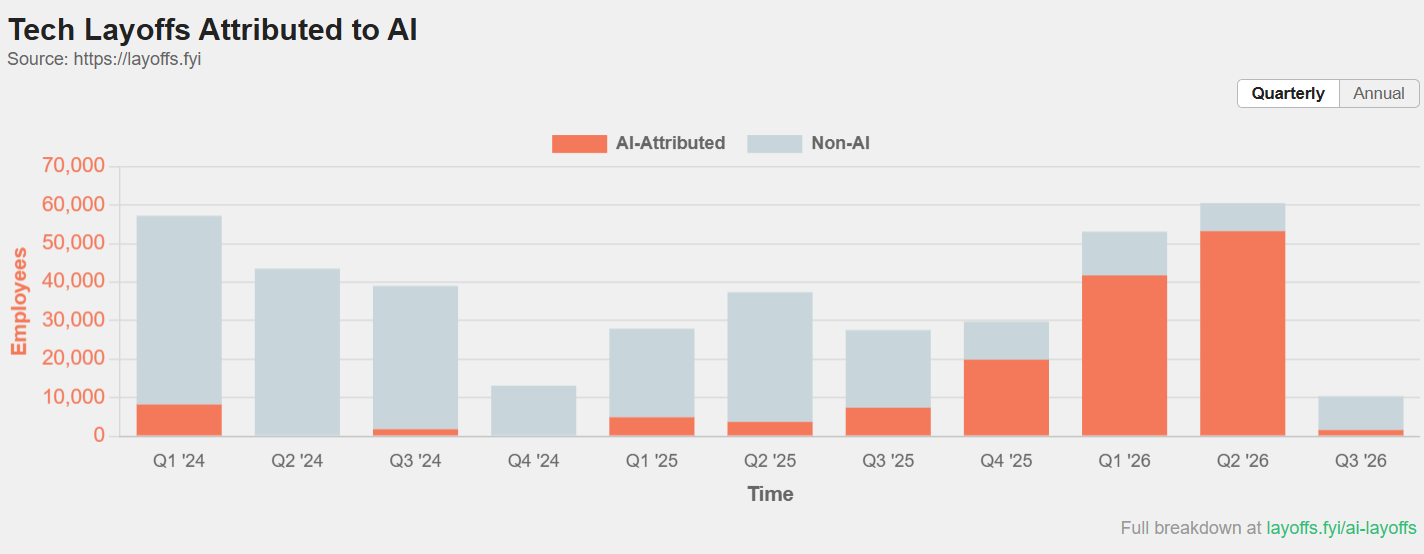
Here is the honest reading of that chart. “Attributed to AI” is a corporate narrative, not proof of cause. Some of these cuts are genuine automation: a task got cheap, so a role shrank. But “AI” is also the most defensible reason a leader can put on a slide, which makes it a convenient label for cuts a company wanted anyway, whether from over-hiring, budget pressure, or a change of strategy. The chart cannot tell you which layoff is which. Neither can the headline.
The AI-attributed share is climbing, but a label is not a cause. Much of this is leadership trading experienced people for cheaper output, with AI as the reason that looks defensible on a slide.
There is a second, quieter force behind a lot of wasted effort too. Because AI lowered the cost of starting things, more half-things get started. A manager spends three weeks building an internal dashboard an existing tool already does. A team chases an AI feature nobody asked for while the work that actually makes money waits.
Before AI-cheap tooling
A weak idea died in review because building it cost too much to justify.
After
The same weak idea ships as a half-built internal tool, because starting felt free, and now three people maintain it instead of working on revenue.
That is scope drift, and it pulls people off the work that grows a business. So where is the safe ground? Not in the raw typing of code, which is the part getting cheap. It is in everything around it: deciding whether the thing should exist, whether it is safe, whether it is cheap enough to run, and whether it actually solved the problem. AI can write a function. It cannot tell your team the function should not have been written. And the roles built on that judgment are not shrinking. As the next section shows with real numbers, they are growing fast.
The 5 software roles that are growing in 2026
None of these are “safe forever.” But they are where hiring demand is visibly pooling, because each one needs a human holding judgment that AI cannot hold end to end. Here is the whole map before we go role by role.
1
AI / ML engineer
Put the model inside the product
2
AI application engineer
Wire AI into apps safely
3
Data engineer
Feed the models clean data
4
Security / AI-safety
Guard a bigger attack surface
5
Platform / AI ops
Run it reliably and cheaply
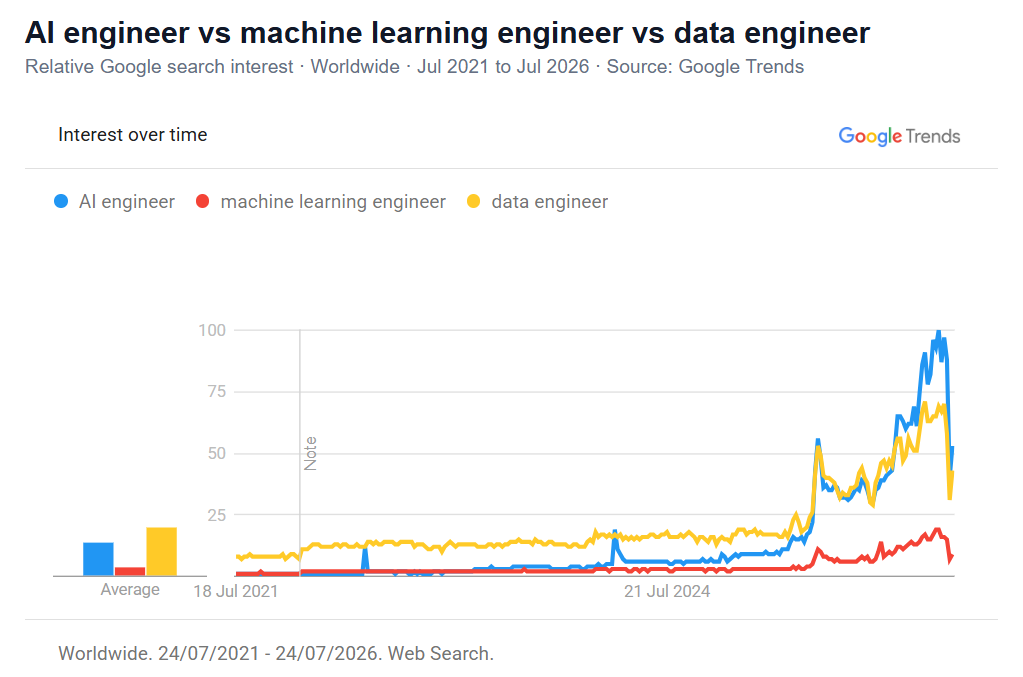
The pattern to notice: every role below is one where AI makes an individual more productive, which raises the value of the human steering it, instead of replacing them. Interest is following that shift, too: worldwide searches for “AI engineer” and “data engineer” have climbed steeply since 2024. That is attention, not proof of hiring, but it tracks where the field is moving.
1. AI / ML engineer: putting the model inside the product
Companies no longer want a chatbot bolted onto the side. They want the model in the product, doing something useful and reliable. That is this role. In practice it is far less “train a model from scratch” and much more data pipelines, evaluation, prompt and retrieval design, deployment, and cost control. If you can take a fuzzy idea like “summarize support tickets accurately” and turn it into something that works consistently and does not blow the budget, you are hard to replace.
What to learn: how large language models actually behave, evaluation and testing of AI outputs, retrieval (RAG) basics, and the cost and latency tradeoffs of running inference.
2. AI application / integration engineer: wiring AI into real apps safely
Every existing app now wants AI features added without breaking, leaking data, or costing a fortune. This is the product engineer who understands prompts, tokens, guardrails, and failure modes well enough to ship an AI feature that behaves in front of real users. It is one of the most accessible of these roles for a working developer, because it builds directly on skills you already have. If you are still building your AI fluency, a plain-English primer like learn prompting for free and a tour of the best AI tools for beginners are good first stops.
Tip: If you are already a frontend or full-stack developer, this is often the shortest bridge into AI work. You are adding a new capability to what you can already do, not starting over.
What to learn: the API patterns of the major AI providers, prompt design, handling and validating AI output, rate limits and cost, and guarding against prompt injection.
3. Data engineer: the plumbing that AI suddenly made valuable
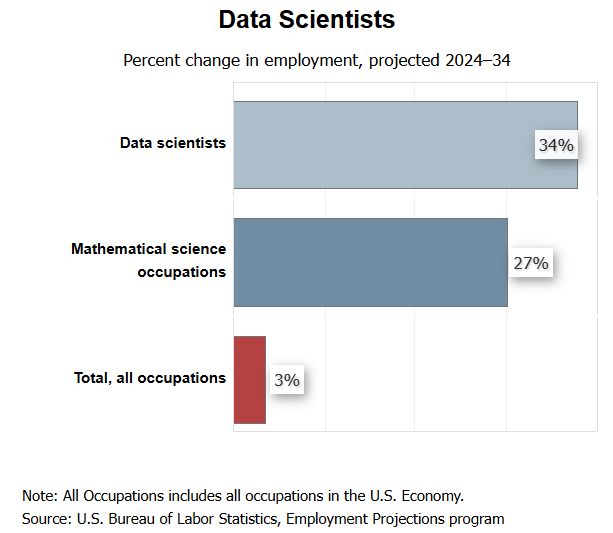
Models are only as good as the data feeding them. That quiet, unglamorous work of moving, cleaning, and structuring data became a lot more valuable the moment every company wanted to build on top of it. Data engineers build the pipelines that make AI features possible in the first place. The demand is not hype: the US Bureau of Labor Statistics projects data-scientist roles (the closest official category) to grow about 34 percent from 2024 to 2034, against roughly 3 percent for all jobs combined.
What to learn: SQL well, pipeline and workflow tools, data modeling, and how to keep data clean and reliable at scale.
4. Security and AI-safety engineer: guarding a bigger attack surface
AI-written code ships faster, and AI-facing features open new doors for attackers. Both expand the surface someone has to defend. This role covers reviewing code (including AI-generated code) for real risk, threat modeling, and defending against new attack types like prompt injection and data leakage through AI features. This is not a small or shrinking field: the US Bureau of Labor Statistics projects information-security-analyst roles to grow about 29 percent from 2024 to 2034, one of the fastest rates of any occupation.
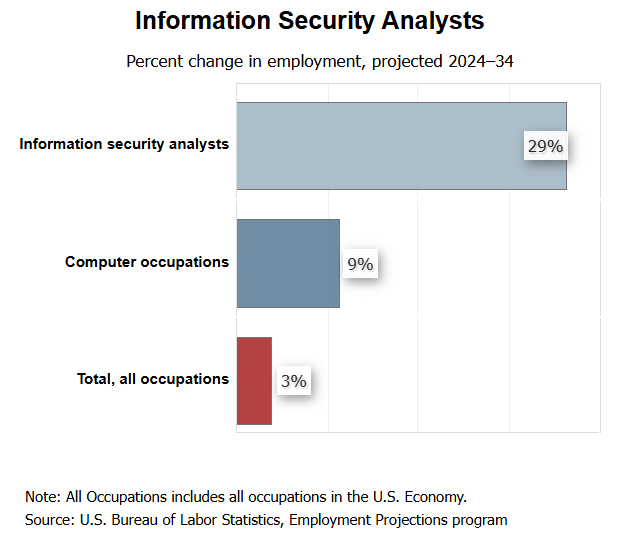
Warning: “AI wrote it, so it must be fine” is how vulnerabilities ship. Reviewing AI-generated code for security is becoming a core skill, not a niche one.
What to learn: secure coding fundamentals, code review with a threat lens, common web vulnerabilities, and the new AI-specific risks (prompt injection, data exposure, model misuse).
5. Platform / DevOps and “AI ops”: running AI reliably and cheaply
Someone has to run all of this in production without it falling over or draining the budget. Platform and DevOps engineers who understand AI workloads are in a strong spot, because inference is expensive and unpredictable compared to normal web traffic. Keeping AI systems reliable, observable, and affordable at scale is real, ongoing work that does not disappear.
What to learn: cloud infrastructure, CI/CD, observability and monitoring, and the specific cost and scaling behavior of AI and inference workloads.
The 5 roles at a glance
| Role | Why AI grows demand | Core skill to build | Good starting point |
|---|---|---|---|
| AI / ML engineer | Companies want the model inside the product, reliably | Model behavior, evaluation, cost control | Ship one small, well-tested AI feature end to end |
| AI application engineer | Every app wants AI features added safely | Prompts, guardrails, API and cost handling | Add an AI feature to an app you already build |
| Data engineer | Models are only as good as their data | Pipelines, SQL, data modeling | Build one clean, reliable data pipeline |
| Security / AI-safety engineer | Bigger attack surface from AI code and features | Secure review, threat modeling, AI risks | Learn to review AI-generated code for risk |
| Platform / DevOps + AI ops | Inference must run reliably and cheaply | Cloud, CI/CD, observability, AI cost | Run and monitor one AI service in production |
Notice what none of these reward: being the fastest person at typing code from a clear spec. They all reward owning a decision AI cannot own. That is the shift the next section makes concrete.
The real shift: from typing code to deciding what to build
If there is one sentence to take from this whole guide, it is this: your value is moving from how fast you can produce code to how well you decide what is worth building and prove it holds up. AI is very good at the first and cannot do the second. Here is what that looks like in practice.
Do
Learn to spec, review, and reject. Reading a change and saying “this is wrong, and here is why” is now more valuable than writing the change.
Don’t
Measure yourself by lines of code produced. That is the exact skill getting commoditized.
Beyond that mindset, four moves keep you hireable.
Get genuinely fluent with AI, instead of avoiding it. The engineer who ships more with AI beats both the one who refuses it and the manager tinkering alone. Be the person who makes the team faster and can explain where AI helps and where it quietly breaks things.
Own one thing AI is bad at. System design under real constraints, cost and latency tradeoffs, security review, or reading a messy legacy codebase. These need context and judgment that a model does not hold, and they are where senior value lives.
Get closer to revenue. Your worry about companies chasing tinkering instead of profit cuts the other way for you as an individual: the engineer whose work clearly maps to money is the last one cut. Understand why your work matters commercially, and be able to say it out loud.
Keep evidence. In a nervous hiring market, a visible track record (shipped features, a small portfolio, a bit of writing or open-source) is what gets you the next seat quickly. A clean, current profile helps too; see how to optimize your LinkedIn profile with AI. Motion is not the same as progress, and being able to show progress beats claiming it.
Common mistakes that make the AI shift harder than it needs to be
Most of the damage people do to their own careers right now comes from a few avoidable reactions.
Refusing to touch AI to “protect your craft.” This is the fastest way to look outdated. You do not have to love it. You do have to be fluent enough to use it well and judge its output.
Chasing every new framework and model. You cannot learn all of it, and trying to is its own kind of scope drift. Pick one of the five directions above and go deep enough to be trusted, then broaden.
Staying a pure code-typer because it feels safe. It feels safe because it is familiar, but it is the single most exposed position. Deliberately take on the “decide and review” work, even when producing code is more comfortable.
A simple 90-day plan to upskill without burning out
You do not need to overhaul your life. You need a direction and steady reps. Here is a realistic sequence for a working developer or a student with limited free hours. If you want a fuller structure to follow alongside it, our beginner AI learning plan breaks the first month into daily steps.
Weeks 1 to 3: pick one of the five directions
Choose the role above that is closest to what you already do. Closest bridge wins; you want momentum, not a cold start.
Weeks 4 to 6: use AI on your real work, deliberately
Bring an AI assistant into your actual tasks and pay attention to where it helps and where it quietly gets things wrong. That judgment is the skill.
Weeks 7 to 9: ship one small thing end to end
A tiny AI feature, one clean data pipeline, one reviewed-and-hardened piece of code. Something real, finished, and yours.
Weeks 10 to 12: make it visible
Write a short post about what you built and what you learned, or put it in a portfolio. Evidence is what converts effort into offers.
Where should you start?
If you are backend or full-stack: AI application and integration engineer is the shortest bridge.
If you love data and SQL: data engineering is the highest-demand plumbing.
If you are a student or early-career: pick the one direction you enjoy most and build one visible project in it. Enjoyment is what keeps you doing the reps.
If you want help pointing your existing skills at open roles, our guide on how to use AI for your job search walks through the practical steps.
Honest caveats
This is analysis, not a crystal ball. Nobody can promise which roles are permanently safe, and the specific hiring numbers behind the headlines change constantly, so treat any single statistic you read (including in other articles) with care and check the source. What does not change is the direction: value is moving from producing code to owning decisions and outcomes. Bet on that, and you are betting on something durable.
Frequently asked questions
Will AI replace software developers?
Not wholesale. AI is replacing specific tasks, mostly the routine production of known code. It is not replacing the judgment of deciding what to build, reviewing whether it is correct and safe, and owning the outcome. Developers who move toward that judgment work are in a strong position.
Is software engineering still worth studying in 2026?
Yes, if you go in clear-eyed. The field is changing, not closing. Focus on fundamentals plus the ability to use AI well and to reason about systems, cost, and safety, rather than only memorizing syntax.
Which software jobs are safest from AI?
The ones where a human owns judgment and consequences: AI/ML, AI application, data, security, and platform roles. Safe is relative, but these are where demand is concentrating because AI raises the value of the person steering it.
Do I need to become an AI expert to stay hireable?
No. You need to become fluent with AI as a tool and go deep in one direction, not become a researcher. Using AI well and owning one thing it is bad at is enough to stay valuable.
How do I start upskilling if I have very little free time?
Pick one direction, use AI on your real work to build judgment, ship one small finished project, and write up what you learned. That sequence fits a few hours a week and produces visible evidence.
The bottom line
AI is not the end of software careers. It is the end of a specific version of the job where value came only from producing code. The developers who thrive from here are the ones who move up the stack, use AI as leverage, own a hard problem it cannot solve, and stay close to why their work matters. Pick one of the five directions, build one visible thing, and you turn a scary headline into a plan.
Ready to point your skills at real openings?
Sources and references
- US Bureau of Labor Statistics, Occupational Outlook Handbook, Information Security Analysts (projected +29 percent, 2024 to 2034).
- US Bureau of Labor Statistics, Occupational Outlook Handbook, Data Scientists (projected +34 percent, 2024 to 2034).
- Google Trends, search interest for AI engineer, machine learning engineer, and data engineer, worldwide, past 5 years.
- Layoffs.fyi, tech layoffs tracker and AI-attributed layoffs breakdown.